Algorithmic Patterns Landscape, Mindset, Approach
It’s 2026, maybe we don’t need this anymore, but the fundamental data structure and why these structures, still critical. But solve these kind of puzzles, AI tool way more efficient than my stupid brain. Let’s organize patterns make this easier to approach.Aha, I don’t like this, but someone may like to do 🤦
💻 The Hardware Reality: Why These Patterns Work
Algorithms are strategies to optimize how we feed data from RAM to the CPU. The goal is to minimize Latency (waiting for data) and maximize Throughput (doing work).
flowchart LR
    subgraph CPU [CPU Core]
        ALU[ALU: Math/Logic]
        Reg[Registers: Immediate Data]
    end

    subgraph Memory [Memory Hierarchy]
        L1[L1 Cache: Super Fast]
        L2[L2 Cache: Fast]
        RAM[RAM: Slow Bottleneck]
    end

    ALU <-->|1 Cycle| Reg
    Reg <-->|~4 Cycles| L1
    L1 <-->|~10 Cycles| L2
    L2 <-->|~100+ Cycles| RAM

    %% Pattern Mappings
    RAM -.->|Sequential Access| Sliding[Sliding Window / Arrays]
    RAM -.->|Random Access| Hash[HashMap / Trees]

    Sliding -->|High Cache Hit Rate| L1
    Hash -->|Cache Misses| L1
| Algo Pattern | Hardware/OS Concept | Why it’s fast |
|---|---|---|
| Arrays / Sliding Window | Spatial Locality | CPU Cache pre-fetches neighbors. Sequential access is king. |
| DP (Tabulation) | Spatial Locality + Reuse | Sequential writes to an array; never re-compute (saves CPU cycles). |
| Recursion / DFS | Stack Memory | Uses the Call Stack (LIFO). Can be slow due to context switching/overhead. |
| HashMap | Random Access (RAM) | Trades memory space to avoid CPU scanning cycles (O(1) vs O(N)). |
| Bitwise | ALU (Arithmetic Logic Unit) | Uses the simplest, fastest CPU circuits (AND, OR, XOR). |
🧠 The Mindset Diagram May Cover 95% Puzzles
flowchart TD
    Start([Read Problem]) --> Input{Input Type?}

    %% 1. Array / String
    Input -->|Array / String| Sorted{Sorted or Range?}
    Sorted -->|Yes, Sorted| BS["Binary Search"]
    Sorted -->|Range Query| Prefix["Prefix Sum"]
    Sorted -->|No| Sub{Subarray / Substring?}
    Sub -->|Yes| Window{Window Condition?}
    Window -->|Fixed/Dynamic Size| Slide["Sliding Window"]
    Sub -->|No| Next{Next Greater/Smaller?}
    Next -->|Yes| Stack["Monotonic Stack"]
    Next -->|No| Pattern{Duplicates / Pairs?}
    Pattern -->|Yes| Hash["HashMap / HashSet"]
    Pattern -->|No| Twoptr["Two Pointers"]

    %% 2. Linked List
    Input -->|Linked List| ListType{Cycle / Middle / Merge?}
    ListType -->|Cycle / Middle| FastSlow["Fast & Slow Pointers"]
    ListType -->|Reverse / Reorder| InPlace["In-Place Reversal"]
    ListType -->|Merge Sorted| Merge["Merge Two Lists"]

    %% 3. Tree / Graph / BFS/DFS
    Input -->|Tree / Graph| TreeType{Tree/Graph Type?}
    TreeType -->|BST| BSTNode["BST Validation"]
    TreeType -->|General Graph| Path{Path Finding?}
    Path -->|Shortest Path| Weighted{Weighted?}
    Weighted -->|No| BFS["BFS"]
    Weighted -->|Yes| Dijkstra["Dijkstra / A*"]
    Path -->|Dependencies| Topo["Topological Sort"]
    Path -->|Explore All| DFS["DFS / Backtracking"]

    %% 4. Optimization / Combinatorial
    Input -->|Combinatorial / Optimization| OptType{Optimization Type?}
    OptType -->|All Combos / Perms| Backtrack["Backtracking"]
    OptType -->|Top K Elements| Heap["Heap / Priority Queue"]
    OptType -->|Min/Max Value| Subproblem{Overlapping Subproblems?}
    Subproblem -->|Yes| DP["Dynamic Programming"]
    Subproblem -->|No| Greedy["Greedy Algorithm"]
    OptType -->|Intervals| Interval["Interval Scheduling"]
    OptType -->|Bit Tricks| Bits["Bitwise Operations"]
    OptType -->|Word/Prefix| Trie["Trie (Prefix Tree)"]
    OptType -->|Union/Group| UF["Union Find"]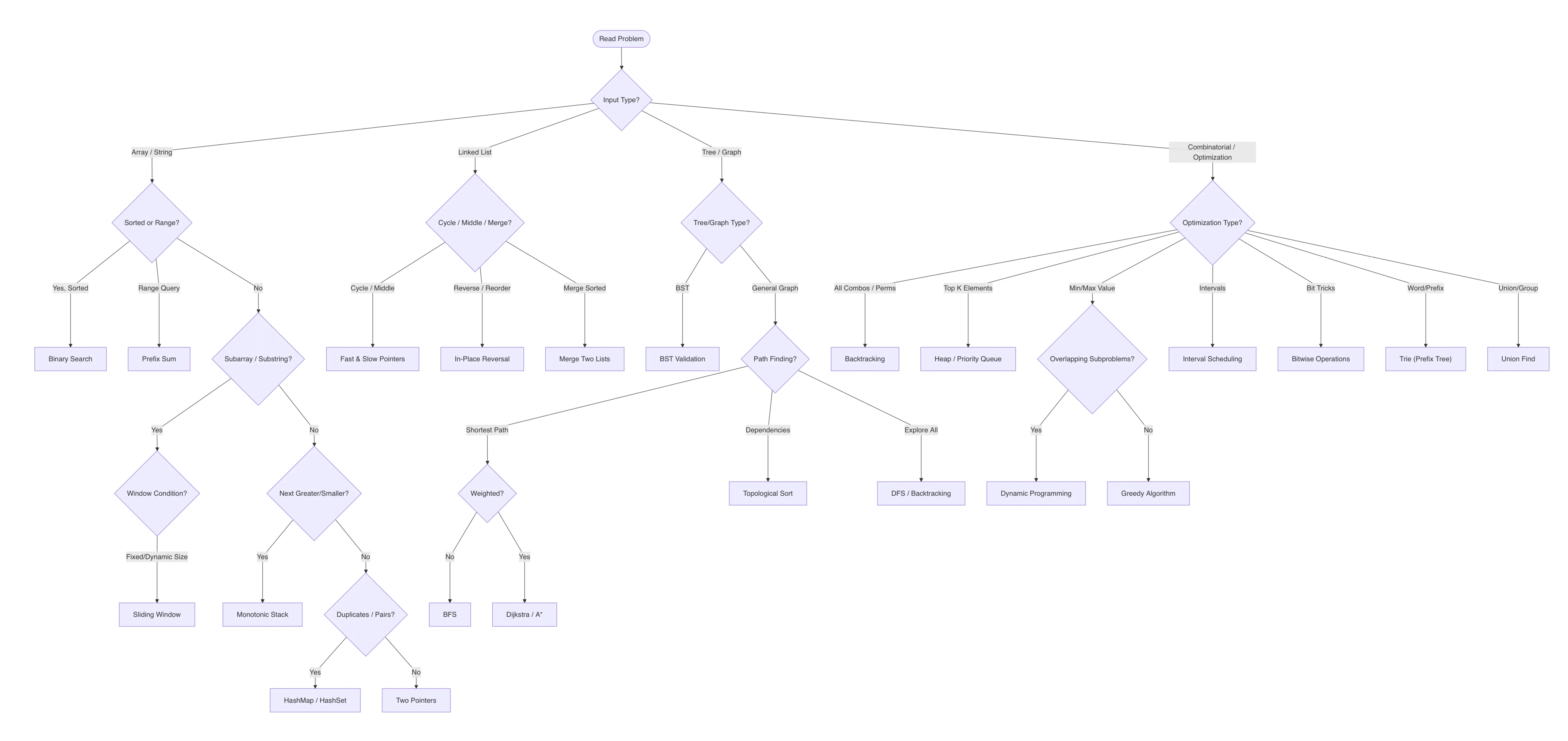
🧠 The Mindset: Trigger -> Template
When reading a problem, look for keywords (Triggers) to identify the underlying pattern. Hands-on coding, need practice and carefully handle edges.